Explore Adventures India logoRequest a tandem
Paragliding training pathway

Learn to fly

From your first ground-handling session to becoming an independent paraglider pilot.

Learn paragliding through a progressive training pathway that combines ground handling and mountain flying development, with winch-based training planned for the future.

Build the foundations first. Learn to understand your wing, develop control and judgment, and gradually progress into different flying environments under qualified supervision.

Every student progresses at an individual pace. Training stages are completed through demonstrated skills, knowledge and instructor assessment, not simply by attending a fixed number of sessions. An enquiry is a request, not a confirmed booking.

Pilot flying a paraglider over open terrain
WhatsApp us about learning to fly
Ground, winch and mountain

Two training environments. One progressive flying journey.

Winch-based training (planned)

Controlled towing from an open field

Winch training allows a paraglider to be launched from a suitable open training field using a controlled towing system.

It can provide a progressive environment for learning launch preparation, wing control, take-off, flight control, release and landing. Training can be structured from foundational ground exercises and low flights towards more advanced supervised flights, depending on the equipment, site, weather and operating procedures.

What it can help you learn

  • Repeated ground-handling practice
  • Understanding the wing before flying
  • Developing launch coordination
  • Learning flight direction and control
  • Understanding towing communication and procedures
  • Practising approach planning and landing
  • Developing consistency through progressive training

Winch-based paragliding training is planned but not yet open. The facility and programme are under development. This activity is not currently available for booking.

Paraglider being towed up by a winch over a flat grass field
Mountain and foot-launch training

Launching from a natural slope

Mountain flying introduces students to launching from a natural slope or mountain site and flying in the surrounding terrain and air environment.

Students learn to assess the launch area, understand terrain and airflow, prepare for take-off, manage the flight, select suitable landing areas and make decisions based on changing conditions.

Learning areas

  • Forward and reverse launch preparation, as appropriate
  • Reading local conditions
  • Understanding terrain and airflow
  • Launch and abort decisions
  • Flight planning
  • Landing approach and field selection
  • Site rules and traffic awareness
  • Understanding mountain-specific hazards

Mountain conversion is not automatic after completing winch training. It requires additional instruction and assessment.

How the two fit together

  1. 1Ground handling
  2. 2Foundation flights
  3. 3Progressive winch training (planned, not yet open)
  4. 4Higher flights and flight control
  5. 5Mountain conversion
  6. 6Mountain flying
  7. 7Soaring and thermalling
  8. 8Cross-country development

The sequence may be adapted to the student's existing experience, the school's operational readiness, available sites and the applicable training framework. Winch and mountain training are complementary environments, not interchangeable qualifications.

Eight stages

Your journey from beginner to independent pilot

Each stage opens with who it is for and what you aim to learn. Open a stage for the theory, practical training and what you need to show before moving on.

Stage 1 of 8

Foundation

Start with the basics. Understand your equipment and learn to control your wing.

Who it is for
Complete beginners with no previous paragliding experience.
Main objective
Develop the fundamental knowledge and ground-handling skills required before progressing into flight training.
Learning environment
Ground training and a suitable training field
Theory, practical training and assessment for stage 1

Theory covered

  • Introduction to paragliding
  • How a paraglider works
  • Main components of the wing
  • Harness, risers, lines and controls
  • Introduction to essential flying equipment and personal safety equipment, including the helmet
  • Reserve parachute familiarisation
  • Basic aerodynamics
  • Lift, drag and weight
  • Relative airflow
  • Basic weather awareness
  • Wind direction and observation
  • Flying-site safety
  • Basic aviation rules and site procedures

Practical training

  • Equipment identification
  • Wing layout and preparation
  • Pre-flight inspection familiarisation
  • Understanding the risers and brake controls
  • Initial inflation exercises
  • Controlling the wing overhead
  • Pitch and roll awareness
  • Maintaining wing position
  • Ground handling in appropriate conditions
  • Safe stopping and packing procedures

What you demonstrate before progressing

You demonstrate safe equipment preparation, understand basic commands, control the wing on the ground and show the coordination and awareness needed to progress.

Outcome

You understand the equipment and have developed the basic skills needed for introductory flying exercises.

What comes next: Stage 2 builds on this with controlled flying.

Student kiting a paraglider wing on the training field

Stage 2 of 8

Higher flights

Move from ground handling towards controlled flying.

Who it is for
Students who have demonstrated the required foundation skills.
Main objective
Develop basic flight control and build confidence through progressively supervised flying.
Learning environment
Ground and mountain. Winch is planned, not yet open
Theory, practical training and assessment for stage 2

Theory covered

  • Basic flight principles
  • Pitch, roll and yaw
  • Airspeed and groundspeed
  • Brake input and weight shift
  • Turning and flight direction
  • Understanding the flight path
  • Basic landing concepts
  • Pre-flight checks
  • Weather and site assessment
  • Radio communication
  • Emergency and abort procedures

Practical training

  • Progressive launch preparation
  • Understanding the launch sequence
  • Supervised introductory flights
  • Maintaining a controlled flight direction
  • Recognising and making appropriate control inputs
  • Understanding turns
  • Flight-path awareness
  • Approach planning
  • Landing preparation and debriefing

Winch training (planned)

Winch training is planned but not yet open or available for booking. It is not part of the training you can currently book.

Mountain training

Introduces the relationship between ground handling and foot-launch preparation. Actual mountain flights require a suitable site, conditions and instructor approval.

What you demonstrate before progressing

You demonstrate reliable preparation, controlled launch and flight behaviour, awareness of the flight path and an understanding of landing procedures.

Outcome

Development towards the relevant beginner pilot qualification and readiness for further supervised training.

What comes next: Stage 3 moves your skills to a mountain site.

Pilot launching a paraglider

Stage 3 of 8

Mountain flying

Transfer your skills to a mountain flying environment.

Who it is for
Students who have developed the necessary foundation and flight-control skills.
Main objective
Learn the additional skills and judgment required to fly from a natural mountain launch.
Learning environment
Mountain
Theory, practical training and assessment for stage 3

Theory covered

  • Mountain-site orientation
  • Terrain and airflow
  • Local wind patterns
  • Valley and slope effects
  • Rotor and lee-side hazards
  • Launch-site selection
  • Weather assessment
  • Site-specific briefings
  • Landing-field selection
  • Airspace awareness
  • Radio and traffic procedures

Practical training

  • Mountain-site familiarisation
  • Ground preparation
  • Launch-area assessment
  • Forward and reverse launch preparation as appropriate
  • Instructor-supervised launch practice
  • Flight planning
  • Landing approach planning
  • Knowing when to delay or abandon a launch
  • Post-flight analysis

What you demonstrate before progressing

You demonstrate an understanding of the site, appropriate launch preparation, safe decision-making and controlled flight and landing under the applicable supervision arrangements.

Outcome

A foundation for progressing in a mountain flying environment.

What comes next: Stage 4 adds ridge soaring.

Pilots at a launch site on a flying trip

Stage 4 of 8

Soaring

Learn to use ridge lift and extend your flying time.

Who it is for
Pilots who have the required basic flying competence and instructor approval.
Main objective
Understand ridge lift and develop safe, consistent soaring skills.
Learning environment
Mountain
Theory, practical training and assessment for stage 4

Theory covered

  • What creates ridge lift
  • Wind direction and terrain
  • Slope and ridge characteristics
  • Lift and sink
  • Wind gradient
  • Terrain-related hazards
  • Traffic rules and right of way
  • Flight positioning
  • Energy management

Practical training

  • Recognising suitable soaring conditions
  • Understanding the ridge environment
  • Maintaining appropriate separation from terrain
  • Positioning relative to the ridge
  • Managing turns and flight direction
  • Recognising changing conditions
  • Landing and top-landing considerations where appropriate

What you demonstrate before progressing

You demonstrate an understanding of ridge dynamics, traffic awareness, appropriate positioning and conservative decision-making.

Outcome

Development of consistent ridge-soaring skills.

What comes next: Stage 5 teaches you to climb in rising air.

A paraglider with a yellow and white wing and a pilot in a dark harness and green helmet flies along a steep, grassy hillside, with a wide valley and a lake in the haze beyond.

Stage 5 of 8

Thermalling

Understand rising air and develop the ability to climb.

Who it is for
Pilots with suitable basic flying experience and instructor approval.
Main objective
Develop an understanding of thermal activity and learn to use lift in a controlled and informed way.
Learning environment
Mountain
Theory, practical training and assessment for stage 5

Theory covered

  • How thermals form
  • Surface heating
  • Thermal triggers
  • Thermal cycles
  • Cloud development
  • Thermal drift
  • Wind influence
  • Thermal indicators
  • Thermal structure
  • Lift and sink
  • Traffic and gaggle behaviour
  • Weather development and overdevelopment risks

Practical training

  • Observing thermal indicators
  • Identifying potential lift
  • Understanding thermal entry and exit
  • Developing turning awareness
  • Recognising drift
  • Maintaining separation from other pilots
  • Monitoring weather and cloud development
  • Deciding when to leave lift
  • Landing planning from altitude

What you demonstrate before progressing

You demonstrate an understanding of thermal behaviour, appropriate traffic awareness, sound decisions and the ability to recognise conditions outside your competence.

Outcome

A foundation for longer flights and cross-country development.

What comes next: Stage 6 takes you beyond the home site.

Four paragliders with orange, yellow, red and white, and light blue wings fly in a deep blue sky beside a towering white cumulus cloud.

Stage 6 of 8

Cross-country flying

Go beyond the local flying site.

Who it is for
Pilots with suitable soaring and thermalling experience who are ready for structured XC development.
Main objective
Learn to plan, manage and complete flights beyond the immediate flying site.
Learning environment
Mountain
Theory, practical training and assessment for stage 6

Theory covered

  • Cross-country flight planning
  • Weather forecasting and interpretation
  • Wind at different altitudes
  • Route selection
  • Airspace and navigation
  • Glide performance
  • Speed-to-fly concepts
  • Terrain and landing options
  • Outlanding preparation
  • GPS and variometer use
  • Retrieve planning
  • Fatigue and decision-making
  • Flight logging and tracking

Practical training

  • Planning a route
  • Identifying alternate landing options
  • Understanding transitions
  • Managing height and glide decisions
  • Evaluating conditions during flight
  • Flying with experienced guidance
  • Post-flight analysis and logging

What you demonstrate before progressing

You can prepare and explain a suitable flight plan, identify hazards and alternatives, and demonstrate conservative decisions throughout the flight.

Outcome

A foundation for independent XC development, subject to applicable ratings and site requirements.

What comes next: Stage 7 is specialist safety training for experienced pilots.

A paraglider with a white wing, a red edge and a dark blue chevron flies high above a wide patchwork of green forest, tan fields and villages, with flat-topped plateaus and hazy mountains on the horizon.

Stage 7 of 8

SIV

Develop a deeper understanding of wing behaviour and recovery.

Who it is for
Experienced pilots who meet the course-specific prerequisites and are accepted by the qualified SIV instructor.
Main objective
Develop knowledge and practical understanding of paraglider behaviour outside normal flight, within a dedicated specialist training environment.
Learning environment
Dedicated specialist training environment
Theory, practical training and assessment for stage 7

Theory covered

  • Wing stability and behaviour
  • Pitch and roll dynamics
  • Energy management
  • Understanding abnormal flight states
  • Passive and active safety
  • Equipment and reserve systems
  • Risk management
  • Training environment and safety arrangements

Practical training

  • SIV exercises are specialist instructor-led activities. The exact programme, sequence and manoeuvres are set by the qualified SIV instructor according to the pilot's experience, equipment, current procedures and training environment.

Conditions

SIV is subject to prerequisites, instructor approval, a suitable location, rescue arrangements and a dedicated safety plan. This page does not describe SIV manoeuvres.

What you demonstrate before progressing

Decided by the qualified SIV instructor, within the course safety plan.

Outcome

Further development of pilot understanding and safety awareness.

What comes next: Stage 8 covers ongoing and specialist modules.

A yellow paraglider wing with black and light blue patterns, partly collapsed on its right side in a deliberate SIV training manoeuvre, with the pilot in a dark suit and helmet beneath it, above a large body of dark blue water with green and brown mountains behind.

Stage 8 of 8

Ongoing and specialist modules

Learning does not stop after a pilot qualification.

Who it is for
Pilots who want to keep developing. These modules are optional and are not required for every student.
Main objective
Optional development modules, each offered as a separate specialist learning opportunity.
Learning environment
Ground and mountain, depending on the module
Theory, practical training and assessment for stage 8

Optional modules

  • Advanced ground handling
  • Launch and landing refinement
  • Active flying clinics
  • Soaring refreshers
  • Thermalling development
  • Cross-country coaching
  • Hike-and-fly preparation
  • Site familiarisation
  • Equipment familiarisation
  • Reserve repacking and safety workshops
  • Flight reviews and mentoring
  • Instructor development, where the relevant qualifications and approval exist

What you demonstrate before progressing

Module by module, agreed with the instructor.

Outcome

Continued development as a pilot.

What comes next: Ready to start? Tell us where you are in your journey.

Paraglider flying at sunset

No stage has a fixed number of days, hours or flights on this page. Stage 7 is described in general terms only, and winch training is planned but not yet open. Details are discussed at enquiry.

Getting started

New to paragliding? Here's how to begin.

  1. Make an enquiryTell us whether you are completely new or already have flying experience.
  2. Speak with the schoolWe discuss your goals, background, training options, location and current programme availability.
  3. Start with an introductionThe Taster Day is an introductory experience for people interested in learning paragliding. Details are confirmed at enquiry.
  4. Begin structured trainingThe instructor assesses your starting point and introduces the appropriate foundation programme.
  5. Progress through demonstrated skillsYour next stage depends on your knowledge, practical ability, experience, conditions and instructor assessment.

Taster day

An introductory experience for people interested in learning paragliding. Rs 7,000 per day, course fee only. Details are confirmed at enquiry.

About the taster day

Pilot course

Structured training in which you move through the stages on demonstrated skills and instructor assessment. Duration and price are discussed on enquiry.

About the beginner course
A group of students standing together on a hillside.
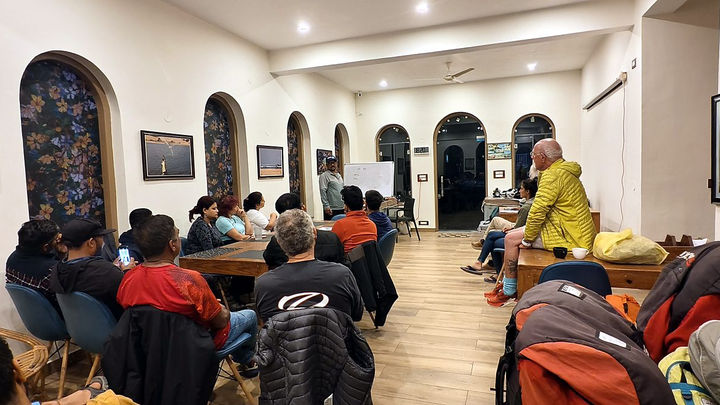
Instructor briefing students before a training session
Standards

Training standards and pilot progression

Our learning pathway is developed with reference to established paragliding education and safety frameworks, including ACI, FAI SafePro Para and APPI. These are separate systems with their own rules and requirements.

The eight stages on this page are our own learning stages. They are not official licence levels.

  • Your progress is recorded and assessed.
  • Qualification requirements depend on the applicable framework.
  • Logbooks and practical assessment are important.
  • Flight numbers, training days, theory requirements and prerequisites must follow the relevant current rules.
  • A qualification or rating is not guaranteed merely by completing a particular number of sessions.
  • Independent flying depends on demonstrated competence and applicable local rules.

Qualification terminology varies by system. It is confirmed with you at enquiry.

Instruction is led by Roshan Lobo: ACI National Level Instructor, FAI IPPI Stage 6, APPI Assistant Instructor course completed.

Theory

What will you learn along the way?

Learning to paraglide is not just about controlling the wing. These topics are introduced at the right stage and reinforced through practical teaching.

Level 1

Foundation knowledge

  • Equipment and components
  • Basic aerodynamics
  • Lift, drag and weight
  • Relative airflow
  • Basic weather
  • Wind observation
  • Site safety
  • Launch and landing principles
Level 2

Developing pilot knowledge

  • Pitch, roll and yaw
  • Airspeed and groundspeed
  • Turns and energy management
  • Meteorology
  • Airspace
  • Flight planning
  • Active flying concepts
  • Traffic awareness
  • Risk assessment
Level 3

Advanced pilot knowledge

  • Thermal meteorology
  • Mountain aerology
  • Ridge dynamics
  • Weather interpretation
  • Glide performance
  • Speed-to-fly concepts
  • Cross-country planning
  • Navigation
  • Human factors
  • Advanced risk management
Assessment

You progress when you're ready, not just when time is up.

Each stage combines theory and understanding, ground preparation, practical exercises, instructor observation, student debriefing, demonstration of the required skills and a progression decision.

  1. Explain
  2. Demonstrate
  3. Practice
  4. Observe
  5. Debrief
  6. Repeat
  7. Progress

Weather, site suitability, safety and your individual learning pace all influence the schedule. We never promise that a student will become independently qualified within a fixed number of days or flights.

Questions

Frequently asked questions

Can I learn paragliding if I have never flown before?

Yes. The pathway starts at Stage 1, Foundation, which is written for complete beginners with no previous experience. You begin with the equipment and learn to control the wing on the ground before any flying.

Do I need previous experience?

Not to begin at Stage 1. If you already have flying experience, tell us about it and we will discuss the appropriate starting point at enquiry.

What is winch-based paragliding training?

Winch training launches a paraglider from a suitable open training field using a controlled towing system. Winch-based paragliding training is planned but not yet open. The facility and programme are under development. This activity is not currently available for booking.

Is winch training the same as mountain flying?

No. They are complementary environments, not interchangeable qualifications. Mountain flying adds launching from a natural slope and flying in the surrounding terrain and air.

Can I learn through winch training and later fly from mountains?

Winch training is planned, so this describes the intended shape of the pathway only. Moving to the mountains is a separate step with its own instruction and assessment. Winch training is planned but not yet open or available for booking.

Do I need to complete mountain training after winch training?

To fly from mountain sites, yes. Mountain conversion is not automatic after winch training. It needs additional instruction and assessment.

How long does it take to learn paragliding?

It depends on the individual, the weather, the site and how quickly you demonstrate the required skills. We do not promise a fixed time. Progress is decided by assessment, not by attending a set number of sessions.

How many flights will I need?

There is no fixed number we can promise. Flight numbers and requirements follow the relevant current rules of the applicable framework, and your own progress. This is discussed during the enquiry.

What about equipment?

This depends on the current programme. We discuss it with you during the enquiry.

Do I need to buy my own paraglider?

This depends on the current programme and your stage. We discuss it with you during the enquiry.

What happens if the weather is unsuitable?

Weather and flying conditions decide, and the instructor makes the call. Sessions may be changed, shortened or stopped, so we do not promise a fixed schedule.

Can I progress to cross-country flying?

Yes, as Stage 6 of the pathway, after soaring and thermalling, with instructor approval and subject to applicable ratings and site requirements.

What is the difference between a taster day and a pilot course?

A taster day is an introductory experience for people interested in learning paragliding. It is priced at Rs 7,000 per day, course fee only. Details of what the day covers are confirmed at enquiry. A pilot course is structured training in which you progress stage by stage through demonstrated skills and instructor assessment.

What qualifications can I work towards?

This depends on the applicable framework. Our learning pathway is developed with reference to established paragliding education and safety frameworks, including ACI, FAI SafePro Para and APPI. These are separate systems with their own rules and requirements. A qualification or rating is not guaranteed by completing a number of sessions. Ask us and we will explain what applies to your situation.

Can an experienced pilot join at an advanced stage?

Yes. Tell us your experience and the instructor will assess your starting point. Soaring, thermalling, cross-country and SIV are discussed at enquiry, and some need instructor approval and prerequisites.

Enquire

Ready to begin your flying journey?

Whether you're starting from zero or already have flying experience, tell us where you are in your journey.

We'll help you understand the appropriate starting point, the training environment and the next steps.

An enquiry is a request, not a confirmed booking. The enquiry form is just below. Choosing a starting point here is added to the WhatsApp message on this page.

More training pages

Go deeper

Taster Day

An introduction before you commit.

Beginner Paragliding Course

The structured pathway for aspiring pilots.

Advanced Training & SIV

Development for pilots, by enquiry.

Not ready to commit? Try a tandem paragliding flight first, or read is paragliding safe.

Talk to the team

Ask us anything.

Message us on WhatsApp or send a short request. Every request is checked by the team. It is a request, not a confirmed booking or flight. Every enquiry comes to Explore Adventures India first. We reply and coordinate with the relevant site.

Loading the enquiry form...

Built with Symphony.co